When flange joints leak during pressure tests, when gaskets blow out during startup, when multi-million dirham projects face schedule delays over failed flange integrity—the root cause often traces to improper bolt tightening. BIJER Construction delivers professional bolt torquing and tensioning services across UAE’s oil & gas facilities, petrochemical plants, and industrial operations where leak-free joints aren’t negotiable—they’re mandatory.
Our certified bolting specialists use calibrated hydraulic torque wrenches and bolt tensioning equipment following ASME PCC-1 guidelines to achieve uniform gasket compression, eliminate flange leaks, and ensure joint integrity under the most demanding service conditions. From routine maintenance re-torquing to critical shutdown turnaround work, we provide the precision bolting expertise that transforms problematic flanges into reliable, leak-free connections across Abu Dhabi, Dubai, and throughout the UAE. Whether supporting pipeline installation commissioning or flange repair after cold cutting modifications, BIJER’s bolting services deliver joints that pass pressure tests on the first attempt.
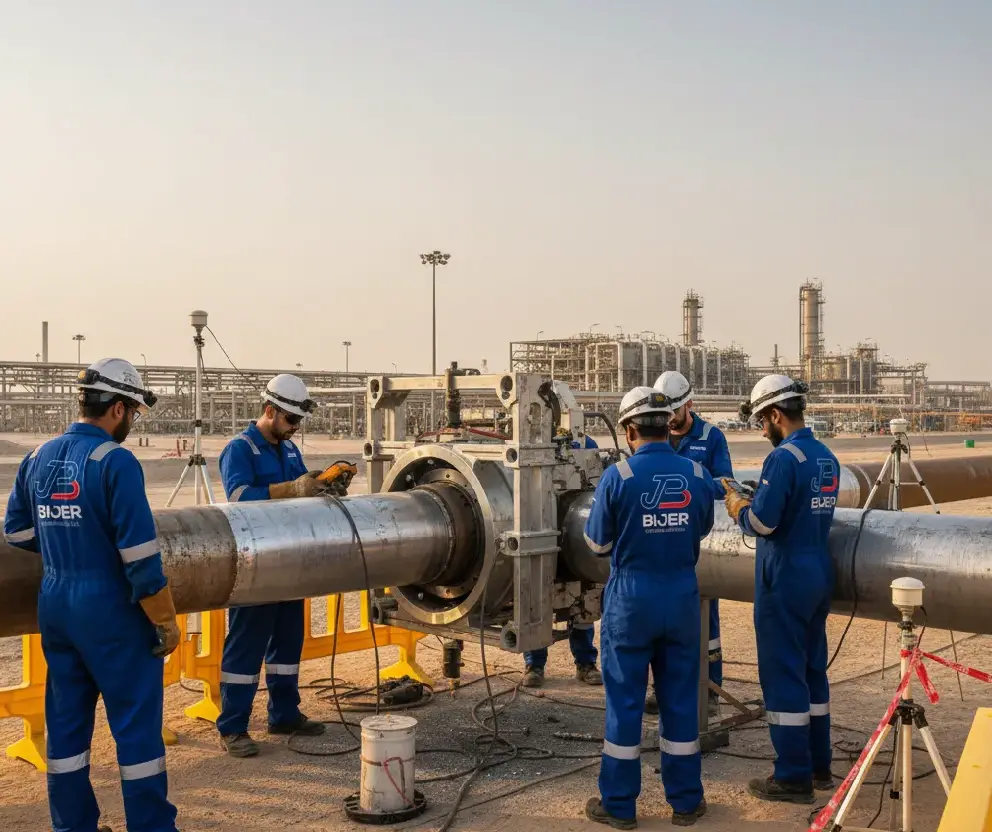
Bolt torquing is the application of precise, controlled rotational force (torque) to fasteners using calibrated hydraulic or pneumatic tools, ensuring uniform tension across all bolts in a flange joint. Unlike manual methods using conventional wrenches that rely on operator “feel” and produce inconsistent results, hydraulic torquing delivers repeatable, accurate bolt loads that create uniform gasket compression—the foundation of leak-free flanges.
Engineering Fundamentals:
Flange joints seal through gasket compression. When bolt tension is insufficient, gaskets don't compress adequately—leaks occur. When tension is excessive, gaskets crush or extrude—leaks still occur. Proper bolting achieves the "Goldilocks zone"—sufficient compression without damage.
Common Bolting Failures:
Technology Advantages
Manual Wrenches (Conventional Method):
Hydraulic Torque Wrenches:
For critical applications—hydrocarbon services, high-pressure systems, high-temperature operations—hydraulic torquing isn’t optional, it’s essential.
Industry Standard for Flange Assembly
ASME PCC-1 "Guidelines for Pressure Boundary Bolted Flange Joint Assembly" establishes best practices for achieving leak-free joints. Key requirements include:
BIJER’s bolting procedures comply with ASME PCC-1, delivering joints that meet ADNOC specifications and international best practices.
Our team knows pipes inside out – from installing new lines to fixing existing ones.
If you would like to discuss your requirements, please call us or complete the enquiry form below. Our team aims to respond quickly on business days; for time-critical matters, we recommend calling.
+971 54 480 6887
info@bijer.ae
BIJER provides comprehensive bolting solutions serving maintenance, turnaround, and construction projects across UAE industrial facilities.
Precision Rotational Tightening
Our hydraulic torque wrench fleet covers bolt sizes from M16 (5/8″) to M140 (5-1/2″), handling applications from small instrument connections to massive pressure vessel closures.
Torque Range Capabilities:
Applications:
Direct Axial Loading Method
Bolt tensioning applies hydraulic force along the bolt axis, stretching the fastener and creating clamping load without rotation. This method offers advantages for specific applications:
When Tensioning Is Superior:
Tensioner Advantages:
BIJER deploys bolt tensioners for critical applications demanding the highest precision—turbine casings, reactor vessel closures, and specialized equipment where rotational methods face limitations.
Fixing Existing Leaks
When operating flanges develop leaks, proper re-torquing often eliminates the problem without disassembly:
Diagnostic Assessment:
Repair Procedure:
Combined with our cold cutting and flange facing capabilities, BIJER restores flange integrity without complete disassembly—reducing downtime and costs.
First-Time Assembly Done Right New pipeline installations, equipment installations, and facility construction demand precise initial bolting:
Our involvement during commissioning prevents the leaks that plague projects where bolting receives inadequate attention.
Rapid Execution During Critical Windows
Refinery and petrochemical turnarounds operate on compressed schedules where every hour counts. BIJER provides:
Typical Turnaround Bolting Scope:
Our shutdown bolting experience ensures joints close correctly the first time—no leaks, no delays, no excuses.
High-Precision Applications
Certain equipment demands bolt tensioning’s superior precision:
Power Generation:
Petrochemical Reactors:
Subsea & Offshore:
BIJER’s bolt tensioning capabilities support these specialized applications requiring the highest integrity and documented bolt loads.
Re-Torquing Under Operating Conditions
Hot bolting allows flange re-tightening while systems remain pressurized and at temperature—eliminating expensive shutdowns for leak corrections:
Controlled Hot Bolting Procedure:
Hot bolting suits applications where process interruptions cost thousands per hour and leak rates are minor but increasing. Note: Not all services permit hot bolting—hydrocarbon systems above 400°C or H2S services often prohibit this method.
ASME PCC-1 Compliant Tightening
Professional bolting follows systematic procedures ensuring uniform gasket compression:
Step 1: Pre-Assembly Inspection
Step 2: Lubrication
Step 3: Initial Assembly
Step 4: Multi-Pass Torquing
Following ASME PCC-1 recommendations, professional bolting uses multiple passes with increasing torque:
Pass 1 (30% of Target Torque):
Pass 2 (60% of Target Torque):
Pass 3 (100% of Target Torque):
Pass 4 (Verification Pass at 100%):
Step 5: Documentation
Optimized Sequences
Proper bolt numbering and tightening sequences prevent flange rotation and achieve uniform gasket compression:
BIJER’s certified bolting technicians know these patterns intimately, executing tightening sequences that achieve optimal results.
Engineering Proper Bolt Loads
Target torque depends on bolt size, material, gasket type, and service conditions. General formula:
T=K×D×F
T=K×D×F
Where:
T
T = Target torque (Nm or ft-lbs)
K
K = Nut factor (friction coefficient, typically 0.15-0.20 for lubricated bolts)
D
D = Nominal bolt diameter (mm or inches)
F
F = Desired bolt tension (N or lbs)
Typical Torque Values (Lubricated Carbon Steel Bolts):
Values vary with bolt grade (ASTM A193 B7, B8, B8M), flange rating (150#, 300#, 600#, 900#, 1500#, 2500#), gasket type (spiral wound, RTJ, flat sheet), and service conditions (temperature, pressure, cyclic loading).
BIJER calculates project-specific torque values or follows client-provided specifications, ensuring bolt loads achieve required gasket stress without exceeding bolt material yield strength.
Comprehensive Size Range
BIJER maintains an extensive inventory of calibrated hydraulic torque wrenches:
Low-Profile Torque Wrenches:
Standard Torque Wrenches:
Heavy-Duty Torque Wrenches:
Square Drive Wrenches:
Reliable Power Sources
Torque wrenches require hydraulic pressure (typically 700 bar / 10,000 PSI). Our power units include:
Multiple power sources ensure we execute work regardless of site conditions—remote locations, classified areas, or facilities without available power.
Documented Accuracy
All torque equipment undergoes regular calibration per ISO 6789-2:
Clients receive documented proof of equipment accuracy—critical for insurance, regulatory compliance, and quality management systems.
Hydraulic Tensioners
Our tensioner inventory covers:
Understanding Joint Mechanics
Flange joints seal through gasket compression creating a barrier against fluid escape. The gasket must:
Minimum Gasket Stress Requirements:
Precision & Consistency
Professional hydraulic torquing addresses root causes:
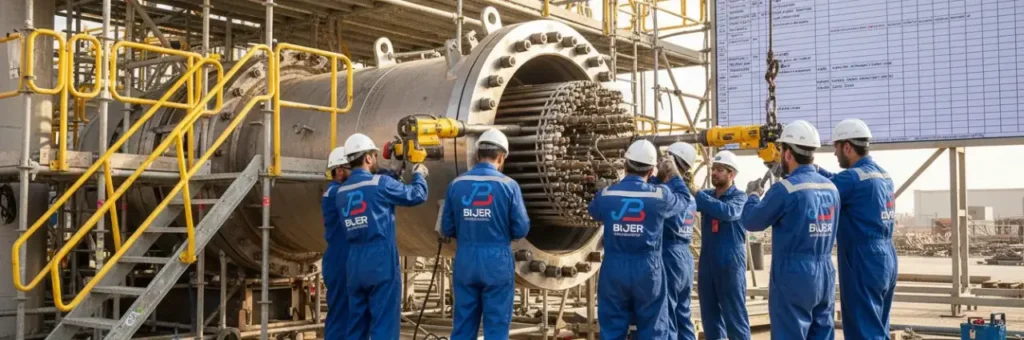
BIJER provides comprehensive bolting solutions serving maintenance, turnaround, and construction projects across UAE industrial facilities.
Upstream, Midstream & Downstream
Complex Chemical Services
Turbine & Boiler Applications
Municipal & Industrial Water Systems
Trained, Experienced Technicians
BIJER's bolting crews aren't general laborers handed a torque wrench—they're certified specialists with documented training:
Certifications & Training:
Documented Accuracy Unlike contractors renting tools on a per-job basis, BIJER owns and maintains a comprehensive bolting equipment fleet:
Complete Project Solutions Bolt torquing rarely happens in isolation. BIJER's integrated capabilities mean:
When Leaks Can't Wait,
No Hidden Costs
Understanding Requirements
Engineering Proper Bolt Loads
Job Readiness
Professional Workmanship
Quality Records
BIJER delivers bolt torquing and tensioning services throughout the UAE:
Abu Dhabi Emirate:
Dubai & Northern Emirates:
Emergency Coverage:
24/7 mobilization across all UAE locations. Pre-positioned equipment at major industrial hubs enables same-day response for critical leak repairs.
Bolt torquing is the application of precise, controlled rotational force to fasteners using calibrated hydraulic or pneumatic tools. Unlike manual wrenches that rely on operator feel and produce ±25% accuracy, hydraulic torque wrenches deliver ±3% accuracy per ISO 6789 standards. This precision ensures uniform bolt tension across all fasteners in a flange joint, creating proper gasket compression and preventing leaks. Hydraulic tools also reduce physical strain, access difficult bolt locations, and provide documentation of applied torque—critical for quality management systems and regulatory compliance in UAE oil & gas facilities.
Bolt torquing costs in UAE vary by flange size, bolt count, and bolt size. Small flanges (1″-6″ with 4-8 bolts) typically cost AED 500-1,500 per flange. Medium flanges (8″-24″ with 8-20 bolts) range from AED 1,500-4,000. Large flanges (24″-48″ with 20-40 bolts) cost AED 4,000-10,000. Extra-large flanges (48″+ with 40+ bolts) may exceed AED 10,000-30,000. Multiple flange projects receive reduced per-unit rates. Confined space work, elevated locations, and emergency mobilizations add 15-30% to base pricing. Professional hydraulic torquing typically costs 30-50% less than manual methods when re-work and leak repairs are factored into total project costs.
ASME PCC-1 “Guidelines for Pressure Boundary Bolted Flange Joint Assembly” is the industry standard for achieving leak-free flange joints. It establishes best practices including: proper flange face preparation, gasket selection guidelines, bolt inspection requirements, lubrication procedures, defined tightening patterns (star/cross sequences), multi-pass tightening with increasing torque, and final verification passes. ADNOC and major UAE operators require ASME PCC-1 compliance for critical joints. BIJER’s bolting procedures follow PCC-1 guidelines, delivering joints that meet operator specifications and pass pressure tests on first attempt.
Yes, in many cases. When flanges develop leaks during operation or pressure testing, proper re-torquing often eliminates leaks without disassembly. BIJER’s process includes: leak location identification, ultrasonic testing to measure remaining bolt tension, root cause analysis (undertorquing, gasket degradation, flange damage), system isolation if required, thread cleaning and lubrication, re-torquing following ASME PCC-1 sequence, and pressure testing to verify leak elimination. If re-torquing fails to stop leaks, we provide cold cutting and flange facing services to repair damaged sealing surfaces, then properly reassemble the joint. This approach minimizes downtime compared to complete disassembly and flange replacement.
BIJER’s hydraulic torque wrench fleet covers bolt sizes from M16 (5/8″) to M140 (5-1/2″) diameter. Torque range spans 100 Nm to 150,000+ Nm, handling everything from small instrument connections to massive pressure vessel closures. We maintain low-profile wrenches for confined spaces, standard wrenches for general applications, and heavy-duty wrenches for large equipment flanges. For bolts exceeding M100 (4″) diameter, we deploy bolt tensioning equipment providing direct axial loading—often superior to torquing for extra-large fasteners.
Duration depends on flange size and bolt count. A small 4-bolt flange (1″-4″) takes 15-30 minutes including setup. Medium 8-bolt flanges (6″-12″) require 30-60 minutes. Large 16-bolt flanges (16″-24″) take 1-2 hours. Extra-large flanges with 40+ bolts may require 3-6 hours. Times include equipment setup, multi-pass torquing (typically four passes per ASME PCC-1), and documentation. Multiple flanges on the same project benefit from equipment already staged—subsequent flanges take less time than initial setup would suggest.
BIJER offers both services. If you have engineering-approved torque specifications, we follow your values precisely. If you need torque calculations, our engineers determine proper values using ASME PCC-1 formulas considering: bolt size and material grade, flange rating and class, gasket type and material, service conditions (pressure, temperature, fluid), and required gasket seating stress. Calculations account for lubrication effects (K-factor) and ensure bolt loads achieve gasket compression without exceeding fastener yield strength. Documentation package includes calculation methodology and supporting references.
Bolt torquing applies rotational force (twisting) to tighten fasteners. Torque creates tension through thread engagement. Bolt tensioning applies direct hydraulic force along the bolt axis, stretching the fastener without rotation. Tensioning advantages include: no friction losses (100% of force becomes tension), elimination of thread galling on stainless/exotic materials, simultaneous tensioning of multiple bolts achieving perfect uniformity, and suitability for extra-large bolts (M100+) requiring extreme loads. Tensioning suits critical applications like turbine casings, reactor closures, and subsea equipment. Torquing is more versatile and cost-effective for typical process plant flanges. BIJER provides both methods, recommending the optimal approach for each application.
Yes. BIJER maintains OSHAD compliance certification and trains all bolting technicians in ADNOC HSE requirements. Our crews hold ASME PCC-1 bolted flange assembly training, equipment manufacturer certifications (Hytorc, Enerpac), and site-specific safety qualifications (hot work permits, confined space entry, work at height). We follow ADNOC permit-to-work systems, SIMOPS management protocols, and incident reporting procedures. Equipment calibration certificates provide traceability meeting ADNOC quality standards. We regularly execute bolting work in ADNOC facilities across Abu Dhabi and Ruwais, maintaining the safety record and quality documentation operators demand.
Absolutely. BIJER provides 24/7 emergency bolting services across UAE. Flange leaks during startups, pressure tests, or operations receive immediate response. We maintain pre-positioned equipment at Mussafah, ICAD, and Ruwais enabling mobilization within 2-4 hours. Emergency services include: rapid leak assessment, root cause identification, on-site re-torquing following proper procedures, hot bolting for minor leaks on operating systems (where safe), and complete flange repair if re-torquing proves insufficient. Emergency response has prevented extended shutdowns, environmental incidents, and production losses for numerous UAE clients. Contact our emergency line (+971 54 480 6887) anytime for immediate assistance.
BIJER’s integrated capabilities deliver complete flange integrity solutions:
New pipeline projects demand proper initial bolting. Our integrated approach combines pipe fabrication, field erection, precision welding, and professional bolt torquing—ensuring joints pass hydrostatic testing on first attempt without leaks or re-work delays.
When flange faces become corroded, pitted, or warped, spark-free cold cutting and portable flange facing restore sealing surfaces to ASME B16.5 specifications. Combined with proper re-torquing, we deliver leak-free joints without expensive flange replacement.
Before assembling critical flanges, high-pressure water cleaning removes scale, corrosion products, and contaminants ensuring proper gasket seating and preventing contamination of downstream systems.
Learn advanced bolting techniques, troubleshooting difficult joints, and cost optimization strategies in our comprehensive technical guide.
When hot work permits become impossible, when safety demands zero ignition sources, when cut quality determines project success—choose BIJER’s professional cold cutting services.
Contact us today for: