Why Flanges Leak: It Is Rarely the Gasket
When a flange joint starts weeping during commissioning or, worse, in service on a live gas line, the immediate assumption is often gasket failure. In our experience across flange-joint work on UAE oil and gas projects, the gasket is rarely the only root cause. The more common problem is non-uniform bolt load.
A flange joint works because the compressed gasket creates a seal by filling microscopic irregularities between the two flange faces. That compression comes from tensile load in the studs. Each stud stretches slightly when tightened, and that elastic stretch maintains the clamping force. If the studs are tightened unevenly, the gasket sees a gradient of compression. The low-load side relaxes first under thermal cycling or pressure fluctuation, and that is where the leak starts.
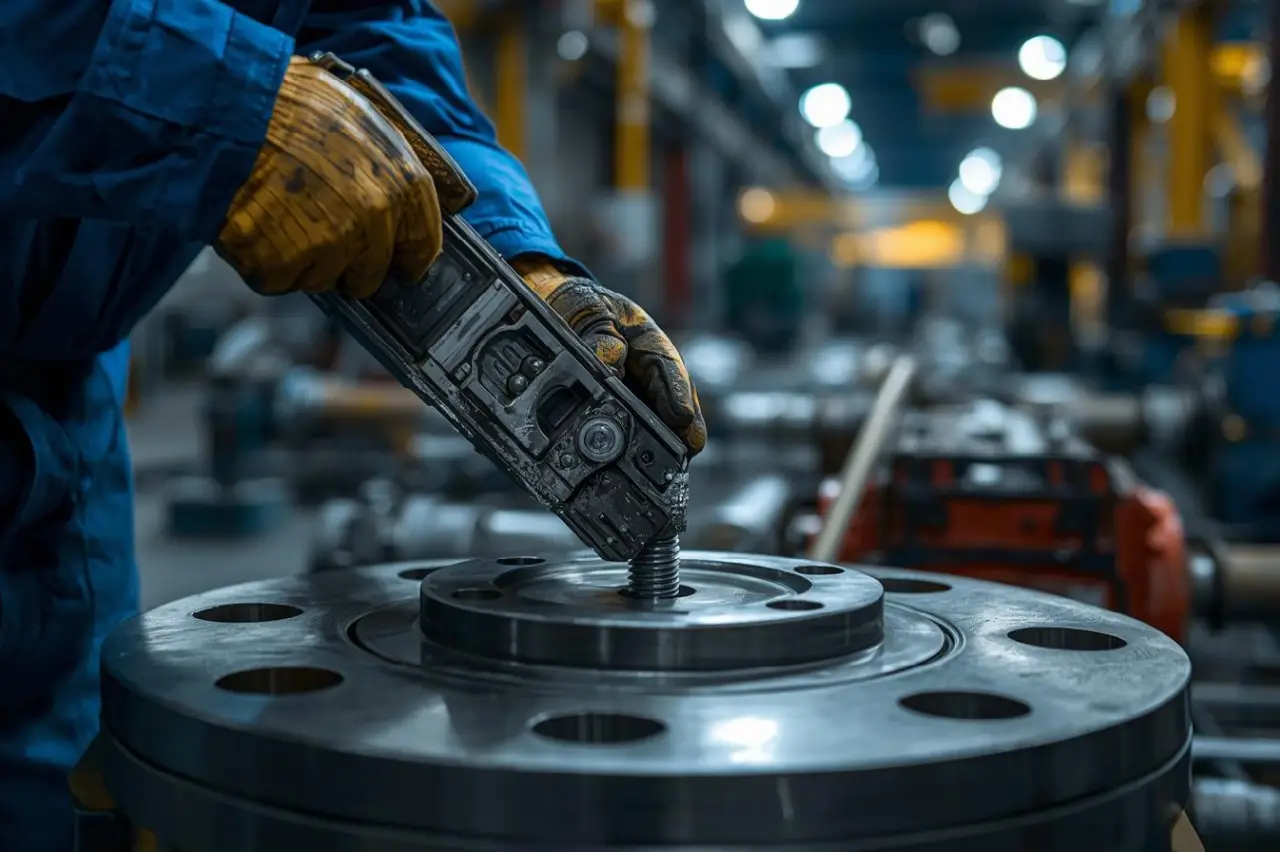
The most common shutdown pattern we see is a joint assembled by feel: a fitter with a manual wrench, bolts tightened in a random sequence, and no torque measurement. After one operating cycle, the uneven bolt loads redistribute and the joint leaks. Controlled bolting, whether by torque or tension, prevents this by applying load in a defined sequence so every stud shares the load within a narrow tolerance band. Our bolt torquing services cover manual torque, hydraulic torque, and tensioning with joint-by-joint documentation.
Torque vs. Tensioning: They Are Not the Same Thing
This is the most important and most misunderstood distinction in flange assembly. Torque is what you apply to the nut with a wrench. Tension is the axial load that actually stretches the stud and clamps the flange. The relationship between the two is not fixed because it depends on friction.
Torque wrench method: You apply a measured torque to the nut. The reading on the wrench dial is only partly converted into stud tension. Friction in the threads and at the nut face consumes a large portion of the applied torque, often 40-50%. This means two identical studs on the same flange, torqued to the same setting, can end up with different actual tension if one has a galled thread or dry nut face and the other is lubricated. This is the nut factor, or K-factor, and per ASME PCC-1, it should be controlled for the selected studs, nuts, and lubricant.
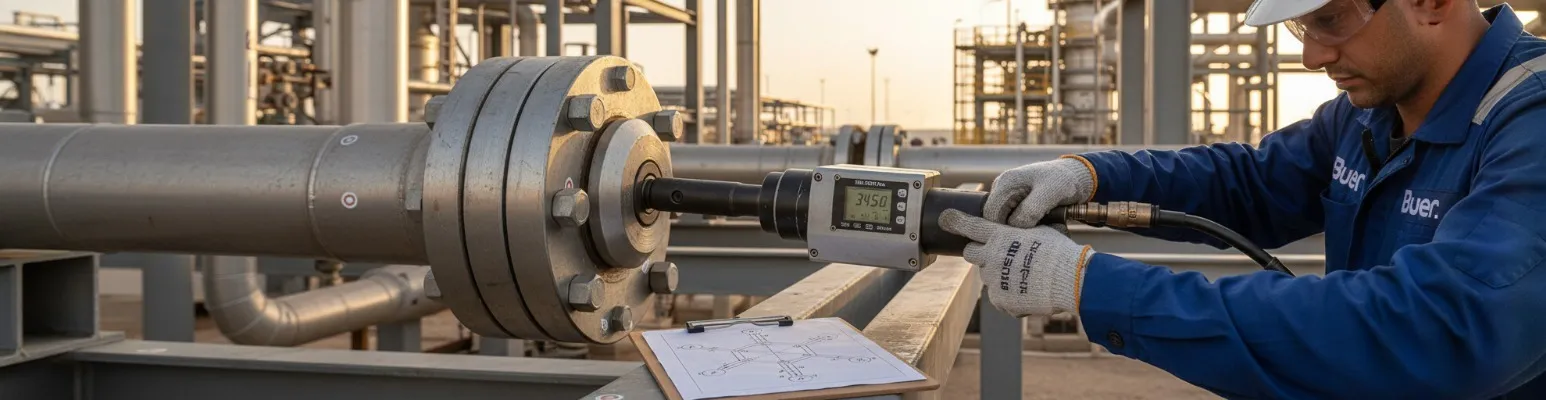
Bolt tensioning method: A hydraulic tensioner pulls directly on the stud end, applying axial load without rotating the nut. Once the target tension is reached, the nut is run down against the flange face and the hydraulic pressure is released. The stud is now pre-loaded to the target tension without relying on a torque-to-tension conversion factor. Tensioning removes much of the friction variable.
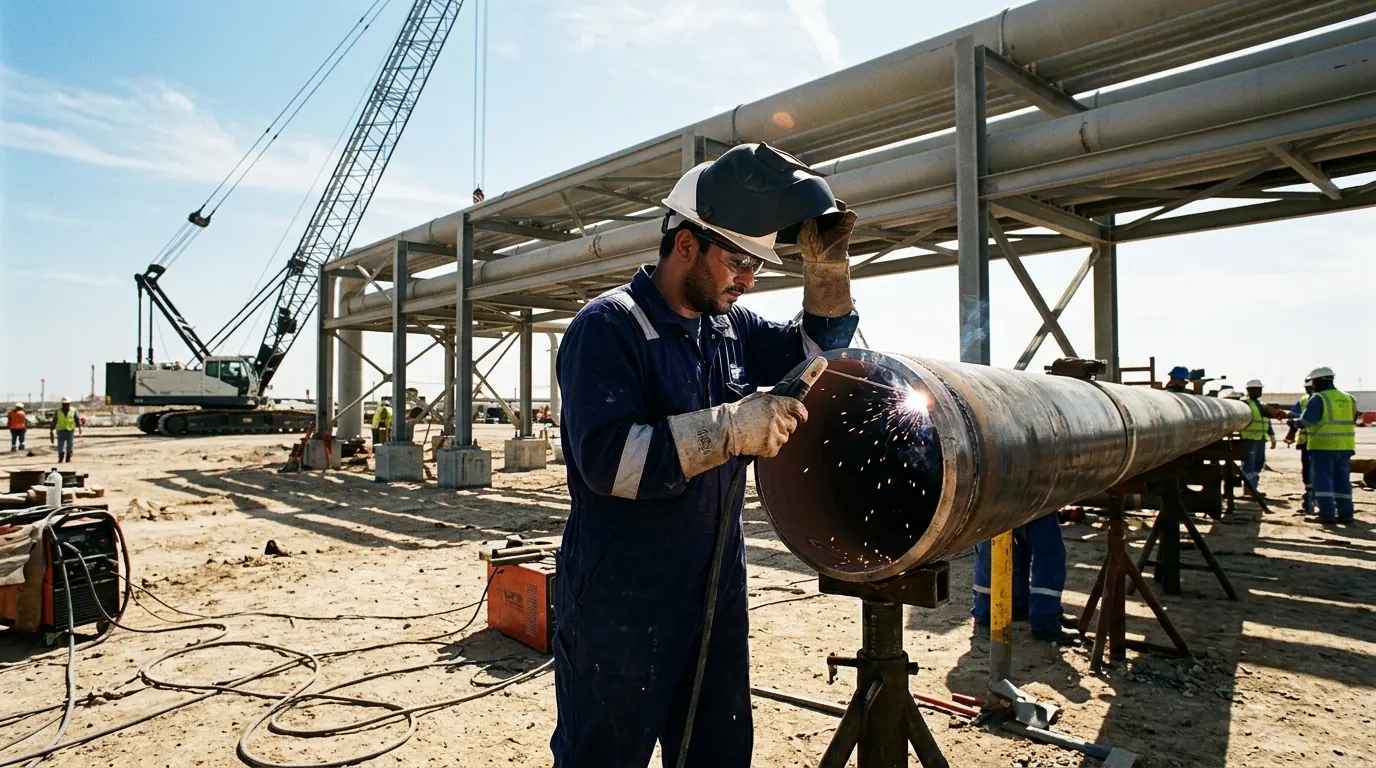
When to use which: For general process piping flanges, calibrated torque wrenches with a documented star-pattern sequence are usually adequate, provided the procedure, lubricant, and K-factor are controlled. For critical flanges such as hydrogen service, high-temperature service, large-bore flanges, or joints where a leak would trigger emergency shutdown, bolt tensioning is preferred. Our piping erection and welding services include flange fit-up with the specified bolting method.
The ASME PCC-1 Assembly Procedure: What It Requires
ASME PCC-1 is the core reference for pressure-boundary bolted flange joint assembly. It turns flange assembly from a craft habit into a controlled procedure. The important requirements are practical, and they matter directly on UAE shutdown and commissioning work.
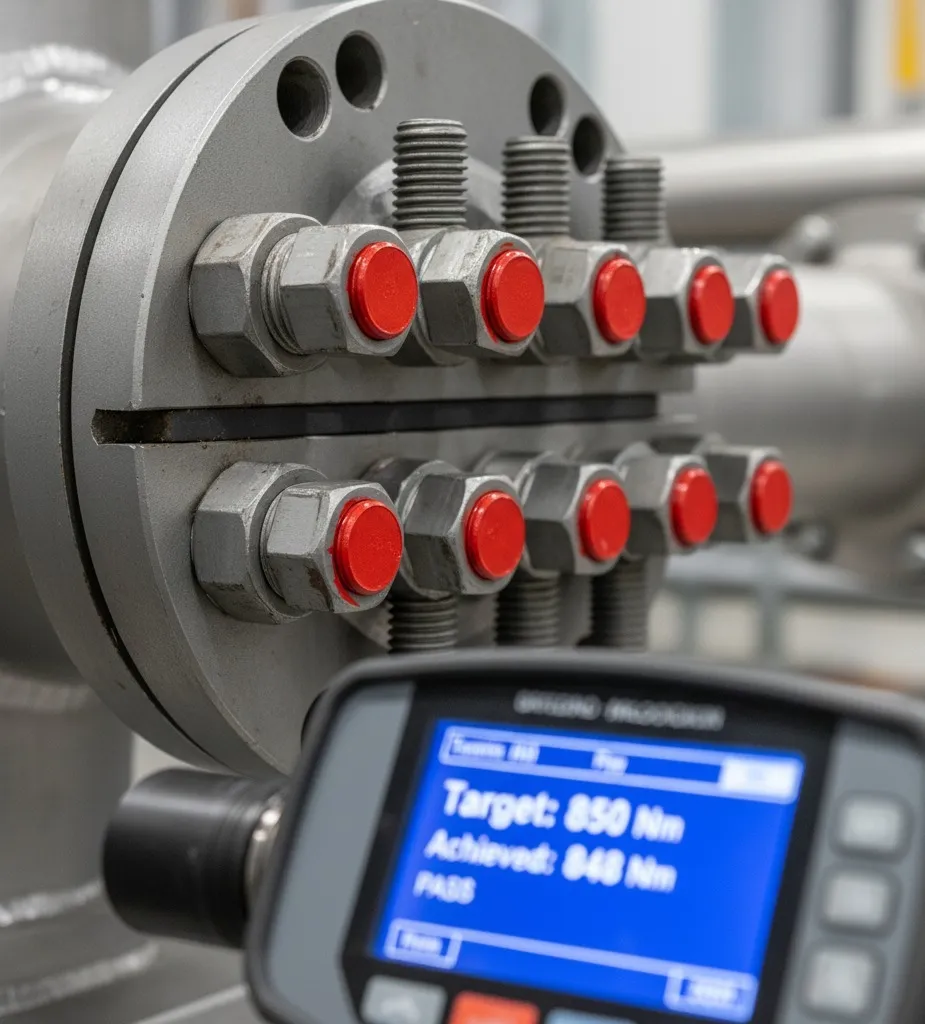
Joint-component verification: Before assembly, verify that the flange material, pressure class, and facing finish match the specification. Confirm the gasket type, dimensions, and material are correct for the service. Verify stud and nut grades such as B7, B16, L7, or B8M, and check for corrosion, galling, or thread damage. Per API RP 578, positive material identification (PMI) should be considered for critical-service bolting to prevent alloy substitution.
Lubrication: Stud threads and nut bearing faces must be lubricated with the specified anti-seize compound. Uneven lubrication produces unpredictable K-factors, which means a torque wrench can show the target value while actual bolt tension varies widely from stud to stud.
Tightening sequence and pattern: Bolts should be tightened in a star or cross pattern in multiple passes. A typical sequence is 30% of target torque, then 60%, then 100%, followed by a clockwise final-pass check at 100%. Skipping the staged approach is one of the fastest ways to create uneven load and a start-up leak.
Documentation: Each joint should have a record showing flange identification, stud count, target torque or tension, actual achieved values, technician, date, and equipment certificate. This becomes part of the quality dossier and makes start-up leak investigation much faster.
Stud Replacement: When Re-Torquing Is Not Enough
During a turnaround, the natural impulse is to re-torque every flange and move on. For many joints, that is appropriate. But when studs show corrosion pitting, necking, or thread galling, re-torquing is a false economy.

Corrosion pitting: In UAE coastal and offshore environments, chloride-laden atmosphere attacks carbon and low-alloy steel studs. Pitting reduces the effective cross-sectional area, so the same torque produces higher stress in the remaining material. A stud that was acceptable when new may now be operating close to yield and can fail in fatigue during the next operating cycle.
Necking and plastic deformation: If a stud has yielded in a previous service cycle, visible as localised diameter reduction, it has permanently elongated. Re-torquing will not restore design preload because the stud has left its intended elastic range. Replace it.
Thread galling: Stainless-steel studs and nuts are particularly prone to galling, where thread surfaces cold-weld under pressure. A galled stud may feel tight at a low torque reading because the threads are binding, but actual stud tension is below target. Replace the stud and nut as a pair.
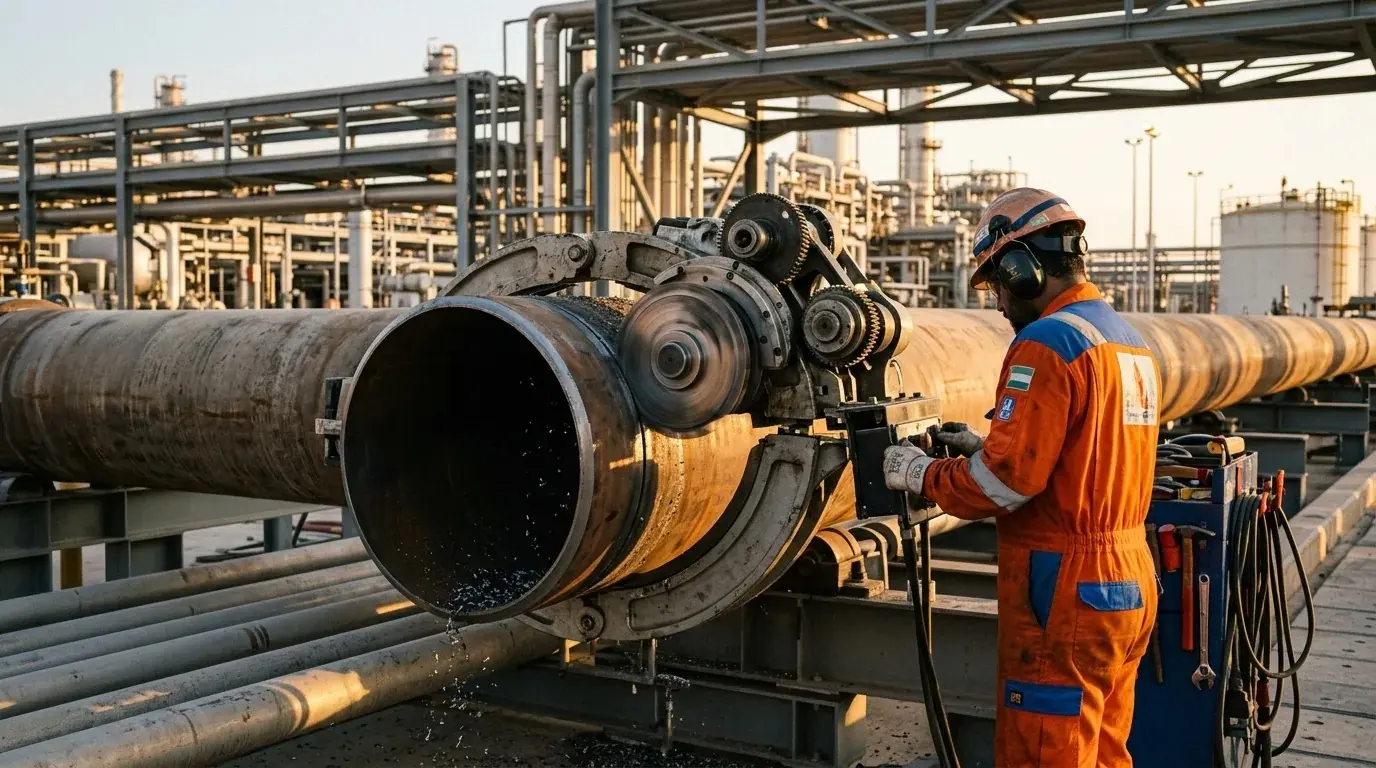
BIJER supports common stud grades used in UAE oil and gas flange work, including ASTM A193 B7, B16, L7, and B8M Class 2 with matching ASTM A194 nuts. If a flange must be opened and cannot be unbolted because of corrosion or seizure, cold cutting for flange replacement can be planned as part of the shutdown scope.
Shutdown and Turnaround: Why Bolting Deserves Its Own QA Plan
In the hierarchy of shutdown risks, welding and lifting usually get the attention. Bolting can be treated as a volume activity, with hundreds or thousands of flange joints being broken, inspected, re-gasketed, and re-torqued in a compressed window. But hydrotest and start-up leak rates are directly tied to bolting quality. Every leaking joint can extend the shutdown by hours or days.
The best risk control is to treat bolting as its own scope with a dedicated QA/QC plan. That means a dedicated bolting crew, calibrated torque wrenches with valid certificates, joint-by-joint torque logs, PMI spot checks on critical studs, and final-pass verification before hydrotest.
At BIJER, we support shutdown and turnaround scopes with dedicated bolting crews working alongside our piping teams. Contact us for a flange-joint survey before your next shutdown. We can assess stud condition, recommend replacement where needed, and provide a bolting plan with a joint count, method statement, and schedule.
For budget planning across the wider piping package, see our piping cost benchmarks. For hot-work-sensitive jobs, our guide on cold cutting vs hot cutting in UAE industrial piping explains when mechanical cutting is safer than thermal cutting.
Frequently Asked Questions
What is the difference between bolt torque and bolt tension?
Torque is the rotational force applied to the nut. Tension is the axial stretching force in the stud that creates flange clamping load. The relationship between torque and tension depends on friction, so identical torque values can produce different stud loads if lubrication, thread condition, or nut-face friction varies. Hydraulic tensioning applies axial load more directly and is preferred for critical flanges.
How do I know if flange studs need replacement rather than re-torquing?
Replace studs that show corrosion pitting, necking or visible diameter reduction, thread galling, damaged threads, or material mismatch found during PMI. Re-torquing a yielded or pitted stud can create a false sense of security because the stud may no longer hold design preload reliably.
What bolt tightening sequence should be used for a flange joint?
Use a star or cross pattern in multiple passes: commonly 30% of target load, 60%, then 100%, followed by a final circular pass at 100%. This staged sequence helps distribute gasket compression evenly and reduces the risk of start-up leaks.
What stud grades are common for UAE oil and gas flange applications?
Common grades include ASTM A193 B7 for general alloy steel bolting, B16 for elevated temperature service, L7 for low-temperature service, and B8M Class 2 for stainless 316 bolting in corrosive environments. Matching ASTM A194 nuts should be selected according to the service and specification.
Do I need Positive Material Identification for flange studs and nuts?
For critical-service flange joints in hydrocarbon, hydrogen, sour, high-temperature, or pressure-boundary service, PMI is strongly recommended. API RP 578 provides guidance for material verification programs and helps prevent accidental material substitution in bolting.